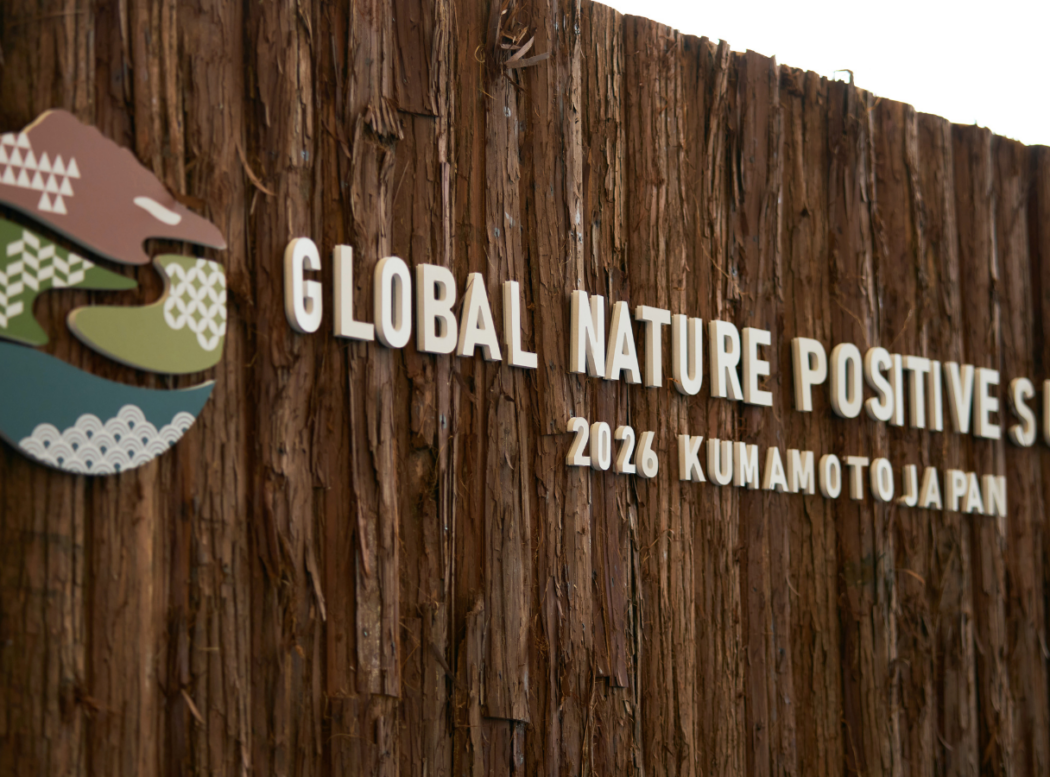
The Kumamoto Ambition for a Nature-Positive Future
We, the organizations participating in the second Global Nature Positive Summit in Kumamoto, Japan, recognize the critical urgency of the upcoming CBD COP17 in accelerating action to deliver the nature-positive goal of halt and reverse biodiversity loss by 2030 on a 2020 baseline, and achieve full recovery by 2050, in line with the mission and vision of the Kunming-Montreal Global Biodiversity Framework (KMGBF). With just four years left to achieve the KMGBF’s mission and global targets, moving from global agreements to grounded action requires an unprecedented “whole-of-society approach” that bridges all actors of society, including governments, civil society, indigenous peoples and local communities, businesses, and financial institutions, citizens, and consumers.
Kumamoto serves as a deeply fitting backdrop. This is a region well aware of how nature sustains economic activity, local livelihoods, food security, cultural heritage, disaster risk reduction, and community resilience. It demonstrates how coordinated actions taken across government, business, finance and social sectors can contribute to nature-positive outcomes for the planet as well as people for both present and future generations. Through its groundwater and river basin management, for example, the region proves that urban centres, corporations and agricultural communities can successfully partner to conserve shared natural resources and ecological processes of which biodiversity is an essential component.
The social and business case for a nature-positive transition is clear. The transition to a nature-positive economy should be recognized not as a cost, but as an investment and an opportunity for sustainable growth, resilience, innovation, and long-term value creation that advances holistic human development and preserves the integrity and vitality of Earth’s systems.
- In support of this ambition, the Kumamoto Global Nature-Positive Summit has highlighted several core elements of achieving a nature-positive future:
- Embracing the vision of the KMGBF, namely that; by 2050, biodiversity is valued, conserved, restored and wisely used, maintaining ecosystem services, sustaining a healthy planet and delivering benefits essential for all people, as well as its 2030 Mission to halt and reverse biodiversity loss and its Goals and Targets. [1]
- Acknowledging the significance of the Intergovernmental Science-Policy Platform on Biodiversity and Ecosystem Services (IPBES) Business and Biodiversity Assessment of February 2026. [2]
- Welcoming the Government of Japan’s National Biodiversity Strategy and Action Plan (NBSAP) 2023-2030: The Roadmap to Realizing Nature-Positive by 2030 and Transition Strategies toward Nature Positive Economy – Creating Corporate Value Based on Natural Capital. [3]
- Urging all companies to apply the mitigation hierarchy to first avoid and minimize negative ecosystem impacts, then contribute to the restoration and regeneration of degraded landscapes and seascapes and, ultimately, compensating for unavoidable impacts while applying high-level integrity safeguards.
- Mobilizing governments, regulators, companies and financial institutions around standardized, science-based but also practical and decision-useful metrics and methodologies to measure corporate impacts and dependencies on nature and the state of nature, accelerating corporate action.
- Aligning markets around a globally consistent, standards-based approach to assessment, target-setting, transition planning and corporate reporting on nature-related issues as called for in the KMGBF Target 15.
- Recognizing natural capital as a vital asset and that nature-based solutions, circularity and decarbonization efforts must be integrated to jointly secure global climate, water and food security, and human health and wellbeing.
- Embracing a Just Transition where climate and nature conservation safeguards and enhances local livelihoods, promote social equity, and empowers marginalized communities, as demonstrated through the Japanese Satoyama model of conserving nature in harmony with human activities.
In recognizing these important recommendations, we will work to ensure the outcomes of this Summit translate into measurable progress towards the goals and targets of the KMGBF by contributing to the CBD process at COP17 and beyond, sharing implementation successes and lessons learned, and strengthening collective action, with the full acknowledgement that the only way we can deliver a people-positive future is by securing a nature-positive one.
SIGNATORIES TO THE KUMAMOTO DECLARATION
Private sector
- AEON Co., Ltd.
- Attero Recycling
- BIOME Inc.
- BioSeed Technologies Inc.
- City Developments Limited
- Daiichi Life Group
- Daiwa House Industry Co., Ltd.
- EY
- EY Japan
- Geosphere Environmental Technology Corp.
- Japan Airlines Co., Ltd.
- Kirin Holdings Company, Ltd.
- Meiji Holdings Co., Ltd.
- MITSUI & Co., Ltd.
- Mizuho Financial Group
- MS&AD Insurance Group Holdings
- NEC Corporation
- Nikkei BP
- Nippon Life Insurance Company
- Nissui Corporation
- NYK Line
- Obayashi Corporation
- Oji Holdings Corporation
- Saraya Co., Ltd.
- Seafood Legacy Co., Ltd.
- Sekisui House, Ltd.
- Seven & i Holdings Co., Ltd.
- SoftBank
- Sompo Japan Insurance Inc.
- Sony Group Corporation
- Sumitomo Forestry Co., Ltd.
- Sumitomo Mitsui Financial Group
- Suntory Holdings
- The Higo Bank, Ltd.
- The Norinchukin Bank
- Think Nature Inc.
- Tokio Marine Holdings, Inc.
- Tokyu Fudosan Holdings Corporation
- Umios Corporation
- Vale
- Yachiyo Engineering
Others (including government, civil society, research and education institutions, standards and disclosure frameworks, business platforms)
- Aso Green Stock Foundation
- Azabu University
- Biodiversify
- BLUERIVIVE General Incorporated Association
- Business for Nature
- Capitals Coalition
- City of Kumamoto
- Conservation International (CI)
- GBIF: the Global Biodiversity Information Facility
- Global Alliance for a Sustainable Planet
- Global Environment Facility
- Global Reporting Initiative
- Global Sustainability Standards Board
- Graduate School of Life Sciences, Tohoku University
- Group on Earth Observations (GEO)
- ICLEI Japan
- Institute for Sustainable Energy Policies
- Insurance Commissioner of California
- International Tropical Timber Organization (ITTO)
- International Union for Conservation of Nature (IUCN)
- Japan Business Initiative for Biodiversity (JBIB)
- Japan Committee for IUCN
- Japan Conference for 2030 Global Biodiversity Framework (J-GBF)
- Japan Environmental Education Forum
- Japan International Cooperation Agency (JICA)
- Japan Standards Association
- Japanese Biosphere Reserves Network
- Japanese Ministry of Agriculture, Forestry and Fisheries
- Japanese Ministry of Environment
- Japanese Ministry of Land, Infrastructure, Transport and Tourism
- Keidanren Nature Conservation Council
- Kumamoto Prefecture
- Nature Conservation Society of Japan
- Nature Positive Initiative
- Nature Positive Landscapes Initiative
- Net Positive
- Rooting Our Own Tomorrows
- Sasakawa Peace Foundation
- Taskforce on Nature-related Financial Disclosures (TNFD)
- UMINEKO Sustainability Institute
- University of Tokyo
- Villars Institute
- Wild Bird Society of Japan
- World Business Council for Sustainable Development
- World Economic Forum
- WWF Japan
References
[1] KMGBF 2050 Vision and 2030 Mission
[3] The National Biodiversity Strategy and Action Plan (NBSAP) of Japan 2023-2030
Sign up to our newsletter
You may
Also like...
-

Information paper: Alignment between State of Nature Indicators and Metrics and the GBF monitoring framework
Connecting business and national biodiversity monitoring
naturepositive.org -

Dozens of leading organizations across sectors welcome State of Nature Indicators and Metrics
Support reflects the deep engagement of a two-year process of consultation and consensus-building as well as the growing market demand for credible and practical tools to support businesses in transitioning towards nature-positive practices.
naturepositive.org -

TNFD, SBTN and Nature Positive Initiative release aligned guidance to strengthen corporate action on nature
Published today: major updates that will help organisations take a more consistent approach across nature-related assessment, target-setting and corporate reporting.
naturepositive.org