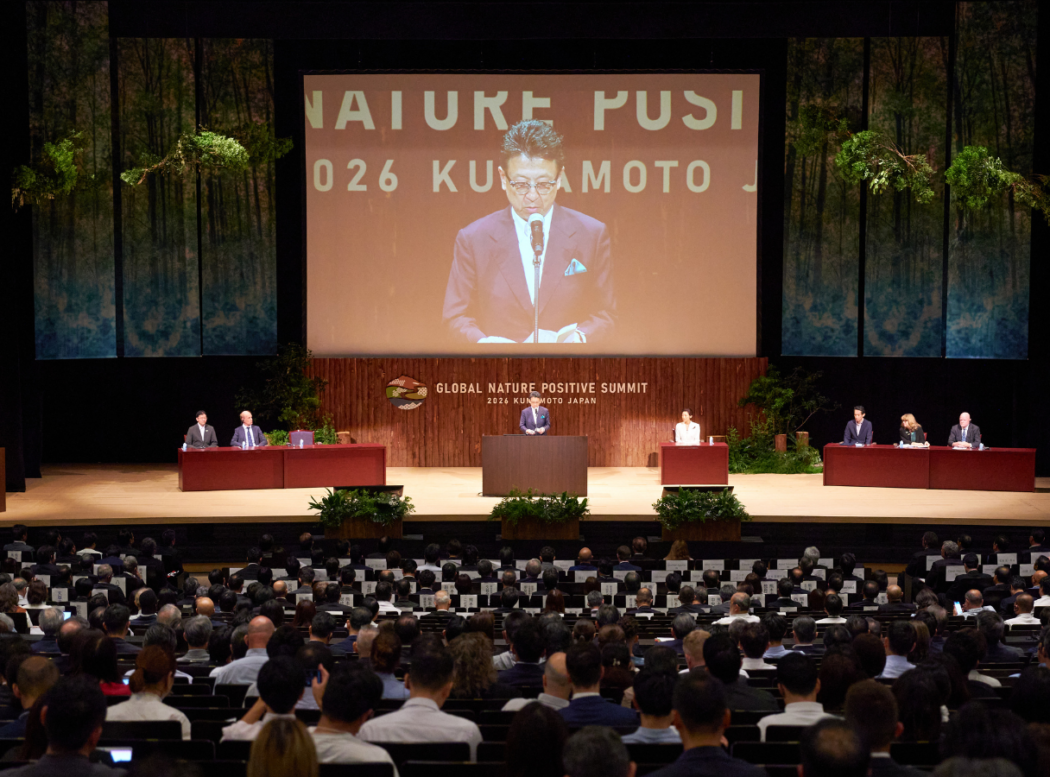
Kumamoto, Japan – 15 July 2026: The second Global Nature Positive Summit concluded today in Kumamoto, Japan, with participating organizations adopting the Kumamoto Declaration. The Declaration underlines the urgency of accelerating action – across all sectors, especially business and finance – towards the nature-positive goal to halt and reverse biodiversity loss, and sets out a shared ambition to strengthen implementation of the Kunming-Montreal Global Biodiversity Framework.
The Summit welcomed 2,725 leaders and delegates. Two thirds of registrations represented the business and finance sectors, alongside civil society, academia, international organizations, media and governments. Industry sectors in attendance ranged from finance, insurance, agriculture and energy, to food, health, construction and transportation.
This large and diverse attendance highlighted the growing recognition of the social and economic case for nature positive – as well as the urgency for a nature-positive transition aligning corporate action with global biodiversity goals, mobilizing finance, and ensuring that it must deliver benefits for people as well as nature.
Plenaries and parallel sessions provided a pivotal opportunity to delve into both the global ambition and the practical actions needed to build a nature-positive society and economy. Several sessions were dedicated to the importance of consistent, science-based approaches to measuring and driving nature-positive outcomes as well as interoperability across standards, reporting and disclosure frameworks.
The Kumamoto Ambition for a Nature-Positive Future, or Kumamoto Declaration – with 87 signatories, almost half of which are private sector – reflects Summit participants’ shared commitment to translating global ambition into measurable action. This comes in a critical year for nature, as 196 governments who are parties to the UN Convention on Biological Diversity will gather in October for COP17 in Yerevan, Armenia, to take stock of progress towards the Global Biodiversity Framework’s 2030 mission and targets.
To achieve a nature-positive future, the Kumamoto Declaration highlights the importance of mobilizing governments, regulators, companies and financial institutions around standardized, science-based but also practical and decision-useful metrics and methodologies to measure corporate impacts and dependencies as well as the state of nature. It also calls for aligning markets around a globally consistent, standards-based approach to assessment, target-setting, transition-planning and corporate reporting on nature-related issues as called for in Target 15 of the Global Biodiversity Framework.
The Summit was honoured by the participation of Her Imperial Highness Princess Takamado of Japan, as well as the endorsement of three Japanese Government Ministries: the Ministry of Environment, the Ministry of Agriculture, Forestry and Fisheries, and the Ministry of Land, Infrastructure, Transport and Tourism. The event was co-organized by the Nature Positive Initiative and International Union for Conservation of Nature (IUCN) Japan Committee, with Nikkei Business Publications as logistical event manager.
The programme included high-level speakers from all sectors across business and society, both Japanese and international, including former Unilever CEO Paul Polman; Hiroyuki Isono, President & CEO of Oji Holdings Corporation (Japan); Shinichiro Funabiki, President and CEO of MS&AD Insurance Group Holdings (Japan); Yuko Tsutsui, Managing Executive Officer, Nippon Yusen Kaisha (Japan); Grazielle Parenti, Executive Vice President Sustainability, Vale (Brazil); Hiroshi Komori, ISSB Board member; Tony Goldner, CEO of TNFD; Jingyu Gao, Economist, Asian Infrastructure Investment Bank (China); UN CBD Executive Secretary, Astrid Schomaker; UNCBD COP17 Presidency’s Special Envoy Ambassador, Mher Margaryan; and many more. The Summit programme was supported by video addresses from UN Secretary-General’s Special Envoy for the Ocean, Peter Thomson; Co-Chair of the World Economic Forum, André Hoffmann; Yoko Watanabe, Director of Nature and Environment, Asian Development Bank; and the Armenian and Australian Ministers of the Environment, whose countries host the upcoming UN CBD COP17 and Climate COP31, respectively.
Today also saw the global streaming launch of the film, Becoming Nature Positive, which is now free for all to watch virtually on YouTube and WaterBear. The film remains available for bespoke screening events via the Nature Positive Initiative’s screening toolkit.
Hosted in Kumamoto, a region recognized for its long-standing approach to integrated water and ecosystem stewardship, the Summit demonstrated how partnerships between governments, businesses, financial institutions and local communities can help deliver positive outcomes for biodiversity, climate and people. A dedicated Nature Tech! forum showcasing innovative technologies in the biodiversity space, and a Youth Symposium organized by the City of Kumamoto engaging local high school students, took place in parallel. 247 local schoolchildren joined the opening day of the Summit.
The Nature Positive Initiative and partners will continue to engage with businesses, financial institutions, governments and civil society to translate the outcomes of the Kumamoto Declaration into tangible action. This will include releasing the State of Nature Metrics framework later in 2026 and supporting greater alignment around science-based approaches to assessment, target-setting, transition planning and disclosure, while fostering collaboration that helps deliver measurable outcomes for nature and people.
With just four years remaining to achieve the Global Biodiversity Framework’s 2030 mission to halt and reverse biodiversity loss, the message from Kumamoto is clear: the knowledge, partnerships and tools are increasingly in place. The priority now is to scale and accelerate implementation through and beyond 2030 with urgency, integrity and ambition, ensuring the world is on a credible path towards a nature-positive future.
The 2026 Summit ended with a message from His Excellency N. Chandrababu Naidu, Chief Minister of the State of Andhra Pradesh, India – announcing that he will host the third Global Nature Positive Summit in October 2027, under the theme ‘From Land to Sea, accelerating green and blue nature-positive food systems’.
Quote from Her Imperial Highness, Princess Takamado of Japan, Honorary President of BirdLife International:
“Human beings are a part of Nature, not apart from Nature. If each one of us could find it within ourselves to temper, even a little, our pursuit of convenience, comfort and material gain, there remains every reason to hope that the delicate balance of our planet’s ecosystems may yet be preserved. Solutions are within reach. Key issues discussed at the Global Nature Positive Summit in Japan include private sector engagement, standardized nature measurement metrics, Indigenous leadership, and the integration of nature-positive objectives with net-zero climate goals. When signing agreements, it is important to not only focus on the details, economic benefits and business investment, but also to step back and consider priorities. This gathering of like-minded people is an important opportunity to discuss possibilities and timelines, and decide courses of action.”
Quote from Hirotaka Ishihara, Minister for the Environment, Japan:
“I welcome the convening of the second Global Nature Positive Summit 2026 in Kumamoto, Japan. Halting and reversing biodiversity loss is essential to maintain the benefits we receive from nature, the very foundation of our society and livelihoods, and ultimately, human wellbeing. The international community has set a shared goal of achieving a “nature positive” world. Many economic activities depend on natural capital, and corporate awareness of nature positive initiatives continues to grow; Japan now has the world’s largest number of TNFD adopters. With this international conference on biodiversity being held in Japan, I feel a deep sense of emotion and anticipation. I hope the Summit will serve as a catalyst for accelerating international efforts toward achieving a nature-positive world.”
Quote from Astrid Schomaker, Executive Secretary, UN Convention on Biological Diversity:
“Biodiversity is our most important form of infrastructure, critical for our economies. This notion has rapidly gained recognition across the world in recent years, particularly since the adoption in 2022 of the ambitious and transformative Kunming-Montreal Global Biodiversity Framework at the Convention on Biological Diversity’s COP 15. Evidence shows that healthy ecosystems underpin resilient economies and support industries and societies in countless ways through ecosystem services, from food production and clean water to climate resilience, protection from disasters, and human well-being. Nature Positive, reflected in the title of this Summit, is not merely a slogan. It is a measurable concept, supported by metrics, such as the “state of nature”, that can help all actors track and strengthen their actions towards halting and reversing biodiversity loss.”
Quote from Marco Lambertini, Convener and Executive Chair, Nature Positive Initiative (Global Nature Positive Summit 2026 co-organizer):
“Nature is the foundation of our economies, our societies and our future. Among the largest global nature-themed conferences, the Kumamoto Global Nature Positive Summit has surely seen the highest proportion of business and finance representatives – a clear sign that the private sector is increasingly considering nature loss as a material risk, and nature conservation and sustainable use of natural resources as an opportunity for business resilience and value creation. What we’ve seen in Kumamoto is growing determination to move beyond commitments and into implementation – at the pace and scale that this decisive decade demands.”
Quote from Teppei Dohke, Chair of IUCN Japan Committee (Global Nature Positive Summit 2026 co-organizer):
“One of the most powerful aspects of this Summit was the extraordinary contribution of the Japanese community – from companies and NGOs to local governments, researchers, youth and many others – through sessions, side events, exhibitions and countless exchanges. This was an opportunity to realize just how much is already happening across the country, led by diverse actors and increasingly through collaboration. Japan also brings an important perspective to the global nature-positive movement: the value of landscapes such as satoyama and other forms of secondary nature that have been shaped and sustained through long relationships between people and nature. I hope that the experiences shared in Kumamoto will contribute to the global conversation, while the connections created will lead to new partnerships and accelerated action.”
Quote from Tetsuya Iguchi, President and CEO, Nikkei Business Publications (Global Nature Positive Summit 2026 manager):
“As a media and information services company, we have prioritized disseminating information regarding social and economic sustainability while also fulfilling our environmental and social responsibilities through our own business activities. As the Kumamoto Declaration indicates, the transition to a nature-positive society should be viewed not as a cost, but as an “investment” that drives sustainable growth, resilience, innovation and long-term value creation. We fully endorse this philosophy and have decided to sign the declaration to contribute – in our capacity as an information provider – to society-wide efforts aimed at the conservation and restoration of biodiversity.”
Quote from Paul Polman, sustainable business leader, investor, philanthropist:
“Nature is not a luxury. Nature is not an environmental issue. Nature is the infrastructure on which every economy depends. Before any company depends on capital markets, it depends on healthy soils, clean water, pollinators, forests, the ocean and a stable climate. Without nature, there is no economy. For too long we have acted as though nature were free, infinite and someone else’s responsibility. It is none of those things. In fact, treating nature as free has become the greatest market failure in history. And correcting that failure is one of the greatest business opportunities of our generation. Nature has moved from the margins of corporate responsibility to the centre of business resilience, competitiveness and long-term value creation. Nature must be visible in every investment decision, every capital allocation decision, every supply chain decision and every boardroom discussion.”
Quote from N. Chandrababu Naidu, Chief Minister of Andhra Pradesh, India (host of Global Nature Positive Summit 2027):
“Andhra Pradesh is honoured to host the Nature Positive Summit 2027 in partnership with the Nature Positive Initiative and the Global Alliance for a Sustainable Planet. With our thousand kilometre coastline, rich agricultural heritage, diverse ecosystems, and millions of communities whose lives are deeply connected with nature, we will bring the world together to demonstrate a new land-to-sea pathway – one that restores ecosystems, strengthens climate resilience, and creates sustainable livelihoods. Together, we can show that protecting nature and advancing prosperity are not competing goals, but a shared opportunity for humanity.”
Please read the press release in Japanese here: https://www.iucn.jp/news_and_topics/news/2026/07/15/16008/
MEDIA CONTACTS:
- Gemma Parkes, Nature Positive Initiative – gparkes@naturepositive.org
- Shizu Kumon, Nikkei Business Publications – gnps2026-press@nikkeibp.co.jp
- IUCN Japan Committee – mail@iucn.jp
Sign up to our newsletter
You may
Also like...
-

Information paper: Alignment between State of Nature Indicators and Metrics and the GBF monitoring framework
Connecting business and national biodiversity monitoring
naturepositive.org -

Dozens of leading organizations across sectors welcome State of Nature Indicators and Metrics
Support reflects the deep engagement of a two-year process of consultation and consensus-building as well as the growing market demand for credible and practical tools to support businesses in transitioning towards nature-positive practices.
naturepositive.org -

TNFD, SBTN and Nature Positive Initiative release aligned guidance to strengthen corporate action on nature
Published today: major updates that will help organisations take a more consistent approach across nature-related assessment, target-setting and corporate reporting.
naturepositive.org