New analysis demonstrates alignment between the recently announced State of Nature Indicators and Metrics and the monitoring framework of the Kunming-Montreal Global Biodiversity Framework (GBF) – creating opportunities for data collected by businesses to contribute to national and global biodiversity monitoring and opportunities to scale.
How do we know if nature is recovering?
It sounds like a simple question. In practice, answering it requires governments, businesses, financial institutions and others to measure changes in ecosystems and species, often at very different scales and for different purposes.
Both governments and businesses need to understand the changes in biodiversity across their jurisdictions and operating areas. They may have different monitoring needs, but not necessarily disconnected monitoring systems.
A new analysis and information paper ahead of the UN Convention on Biological Diversity (CBD)’s COP17 in October 2026, developed under the guidance of the CBD Secretariat and the Nature Positive Initiative Secretariat, led by Prof Emily Nicholson examines how the State of Nature (SoN) Indicators and Metrics align with the GBF monitoring framework headline indicators.
The results show substantial areas of alignment and an opportunity to connect biodiversity information collected via the private sector with the national and global systems used to monitor progress towards the GBF – and ultimately to support progress towards halting and reversing nature loss.
Different scales, a shared picture of nature
The GBF provides the global framework for action to halt and reverse biodiversity loss. Its monitoring framework includes 27 headline indicators agreed by Parties for national reporting. The role of business is also explicit: Target 15 calls for governments to support businesses to monitor, assess and disclose their biodiversity-related risks, dependencies and impacts.
The State of Nature Indicators and Metrics published by the Nature Positive Initiative following two years of consensus building and pilot testing approach the same challenge from another direction.
The four indicators – ecosystem extent, ecosystem condition, species extinction risk and species populations – are designed to provide a consistent way of measuring whether the state of nature is declining or recovering, and are important in helping businesses and financial institutions to understand their dependencies and impacts on nature, identity risks and opportunities and ultimately building business resilience. They can be applied at site and landscape or seascape contexts and at different levels of granularity, allowing organizations to progress towards more ecologically meaningful and technically advanced measurement as data and capacity improve.
National governments need information that can be aggregated across entire ecosystem types, species ranges and countries. A company managing a mine, farm, infrastructure project or supply chain may need sufficiently detailed information to understand what is happening to nature in the places connected to its activities.
The question is not whether these systems are identical. It is whether they are sufficiently aligned that the same concepts, standards and underlying biodiversity data can contribute to both.
Substantial alignment between the metrics
The analysis assessed both conceptual alignment – whether the metrics measure the same aspects of nature – and operational alignment, including whether they use compatible data, methods, units and approaches.
Two of the State of Nature Indicators and Metrics show particularly strong alignment with GBF headline indicators:
- Ecosystem extent is fully aligned with GBF headline indicator A.2, Extent of natural ecosystems. Both measure changes in the area of natural ecosystems, using aligned concepts, definitions and methodological approaches. This alignment holds across the different granularity levels of the metric.
- Species extinction risk is substantively aligned with GBF headline indicator A.3, the Red List Index. Both are concerned with reducing extinction risk and draw on similar data and approaches, including information from the IUCN Red List of Threatened Species.
The GBF currently has no dedicated headline indicators for either ecosystem condition or species abundance. The State of Nature Indicators and Metrics also don’t capture ecosystem collapse risk, but rather have elements of condition and extent. This means these areas are not simply gaps between the two approaches: they are opportunities for investment in better methods and data. Taken together, the findings show that corporate and national biodiversity monitoring can speak much more of the same language than might be assumed.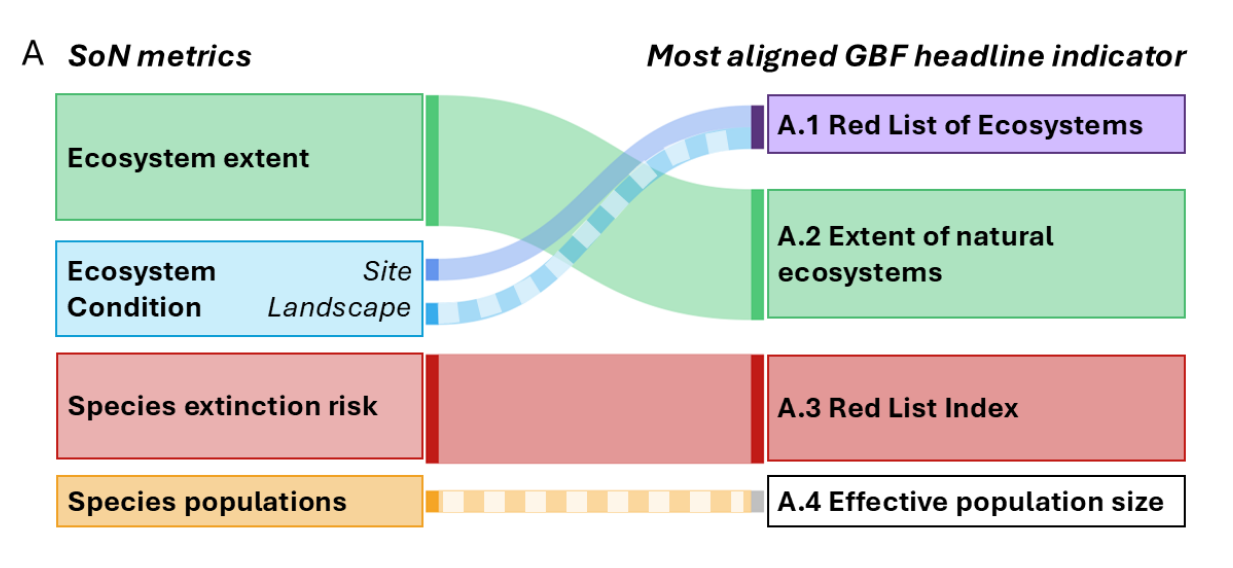 Figure 3 of the Info Paper. Alignment of the State of Nature Indicators and Metrics with (A) the most aligned GBF headline indicators, and (B) all aligned or potentially aligned headline and component indicators, with component indicators marked in grey and with an asterisk; weight indicates levels of alignment from Table 3 (thick = full or substantive alignment, thin = methodological, dashed = potential for methodological alignment).
Greater granularity can create stronger alignment
One of the findings is the importance of granularity.
The State of Nature Indicators and Metrics allow organizations to measure nature at preparatory, medium and high granularity. Preparatory is designed to encourage companies to get started on their nature-positive journey. Higher granularity means greater ecological and spatial detail, generally accompanied by greater data requirements and, where relevant, ground-truthing. This will help provide additional insights for companies who are keen to more deeply understand risks they may face. That additional detail can also make the information considerably more useful beyond an individual organization – including for alignment with national reporting.
The analysis makes the direction of travel clear: as data and capacity improve, moving towards higher-granularity measurement can strengthen both the ecological value of corporate monitoring and its alignment with national and global biodiversity monitoring.
From corporate data to a shared biodiversity evidence base
Around the world, businesses and financial institutions are being asked to better understand their relationship with nature. Frameworks and initiatives including TNFD, GRI and SBTN, alongside evolving sustainability reporting requirements, are creating growing demand for credible biodiversity information. The State of Nature Indicators and Metrics have been developed with these use cases in mind.
At the same time, governments face major biodiversity data gaps, and there are initiatives where these efforts overlap, such as ISSB, EFRAG, GRI, CDP and ISO that link private and jurisdictional or regulatory needs. If these two worlds develop separately, we risk investing significant resources in parallel monitoring systems: businesses collecting one set of data for corporate purposes while governments and researchers collect another for national and global monitoring.
Alignment offers another possibility.
When businesses measure ecosystem extent, condition, extinction risk and species populations using compatible classifications, methodologies and data standards, the underlying information has the potential to contribute to a much wider biodiversity evidence base.
The paper identifies opportunities for data generated through the State of Nature Indicators and Metrics to support existing indicators and databases, including the Red List of Ecosystems, Red List of Threatened Species, Living Planet Index and global biodiversity data infrastructure such as GBIF.
That relationship can work in both directions. Businesses need access to robust foundational information – including ecosystem maps and species data – to understand their dependencies, impacts, risks and opportunities. Governments and the scientific community, meanwhile, could benefit from appropriately standardized data generated through private-sector monitoring.
Building the bridge between local action and global goals
Ultimately, state of nature measurement can help connect corporate and national indicators to assess whether actions are contributing to nature recovery. Much of the foundation already exists; the priority is to improve measurement quality and granularity, strengthen common standards and methodologies, and enable biodiversity data to flow between private, public and scientific monitoring systems.
Strengthening this bridge can improve coherence, reduce duplicative reporting and build the shared evidence base needed to track progress towards halting and reversing nature loss.
Read the State of Nature Indicators and Metrics
Sign up to our newsletter
You may
Also like...
-

Dozens of leading organizations across sectors welcome State of Nature Indicators and Metrics
Support reflects the deep engagement of a two-year process of consultation and consensus-building as well as the growing market demand for credible and practical tools to support businesses in transitioning towards nature-positive practices.
naturepositive.org -

TNFD, SBTN and Nature Positive Initiative release aligned guidance to strengthen corporate action on nature
Published today: major updates that will help organisations take a more consistent approach across nature-related assessment, target-setting and corporate reporting.
naturepositive.org -
Landmark universal State of Nature Indicators and Metrics equip businesses and investors in understanding their nature-related dependencies, impacts, risks and opportunities
The Nature Positive Initiative today launched a landmark new set of indicators and metrics for measuring the state of nature
naturepositive.org